CIE iGCSE Co-Ordinated Science C2.2 Atomic structure and the Periodic Table Exam Style Questions Paper 1
Question
One atom of an isotope of fluorine is represented by \( ^{15}_{9}\text{F} \).
How many neutrons does this atom have?
A. 6
B. 9
C. 10
D. 15
▶️ Answer/Explanation
In the nuclide notation \( ^{A}_{Z}\text{X} \):
- The top number (A) is the nucleon number (mass number), which is the total number of protons and neutrons in the nucleus.
- The bottom number (Z) is the proton number (atomic number), which is the number of protons in the nucleus.
For \( ^{15}_{9}\text{F} \):
- Nucleon number = 15
- Proton number = 9
The number of neutrons is found by subtracting the proton number from the nucleon number:
\(\text{Number of neutrons} = 15 – 9 = 6\)
Therefore, this atom of fluorine has 6 neutrons. Option A is correct.
✅ Answer: (A)
Question
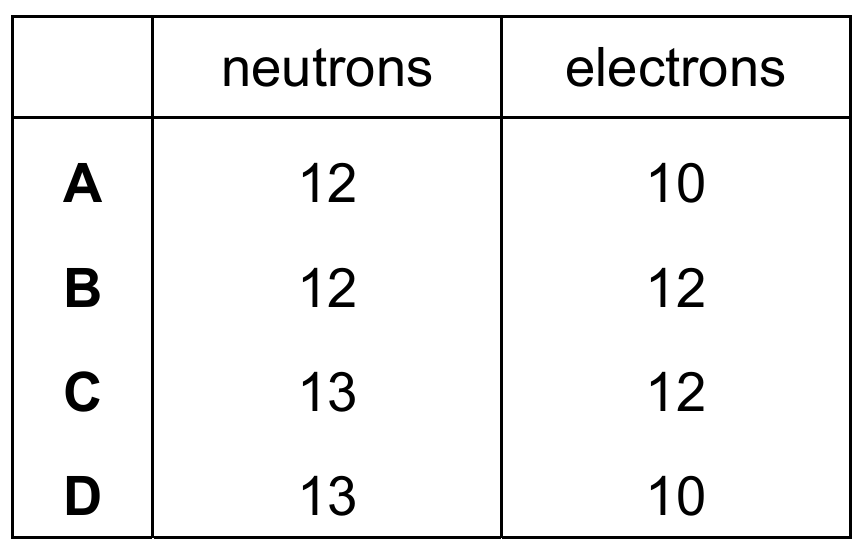
Which row describes particles present in \(^{25}_{12}\text{Mg}^{2+}\) ?

▶️ Answer/Explanation
✅ Answer: (D)
Question
An atom of phosphorus has a nucleon number of 31 and a proton number of 15. How many neutrons are there in this atom?
A. 15
B. 16
C. 31
D. 46
▶️ Answer/Explanation
The atom contains 16 neutrons.
Protons and electrons would each be 15 in a neutral atom.
✅ Answer: (B)
Question
Atoms consist of protons, neutrons and electrons.
Which statement is correct?
A. An electron has a relative mass of 1 and a negative charge.
B. A proton has a relative mass of 1 and a positive charge.
C. A proton has a relative mass of less than 1 and a negative charge.
D. A neutron has a relative mass of less than 1 and no charge.
▶️ Answer/Explanation
✅ Answer: (B)
Question
What is the nucleon number of the potassium isotope \(^{40}_{19}\mathrm{K}\) ?
A. 19
B. 21
C. 40
D. 59
▶️ Answer/Explanation
✅ Answer: (C)
